Work serves a purpose.
Before deciding how to do something, ask what it needs to achieve, and whether it needs to happen at all.
The question it requires
What result is needed? What work can we remove?
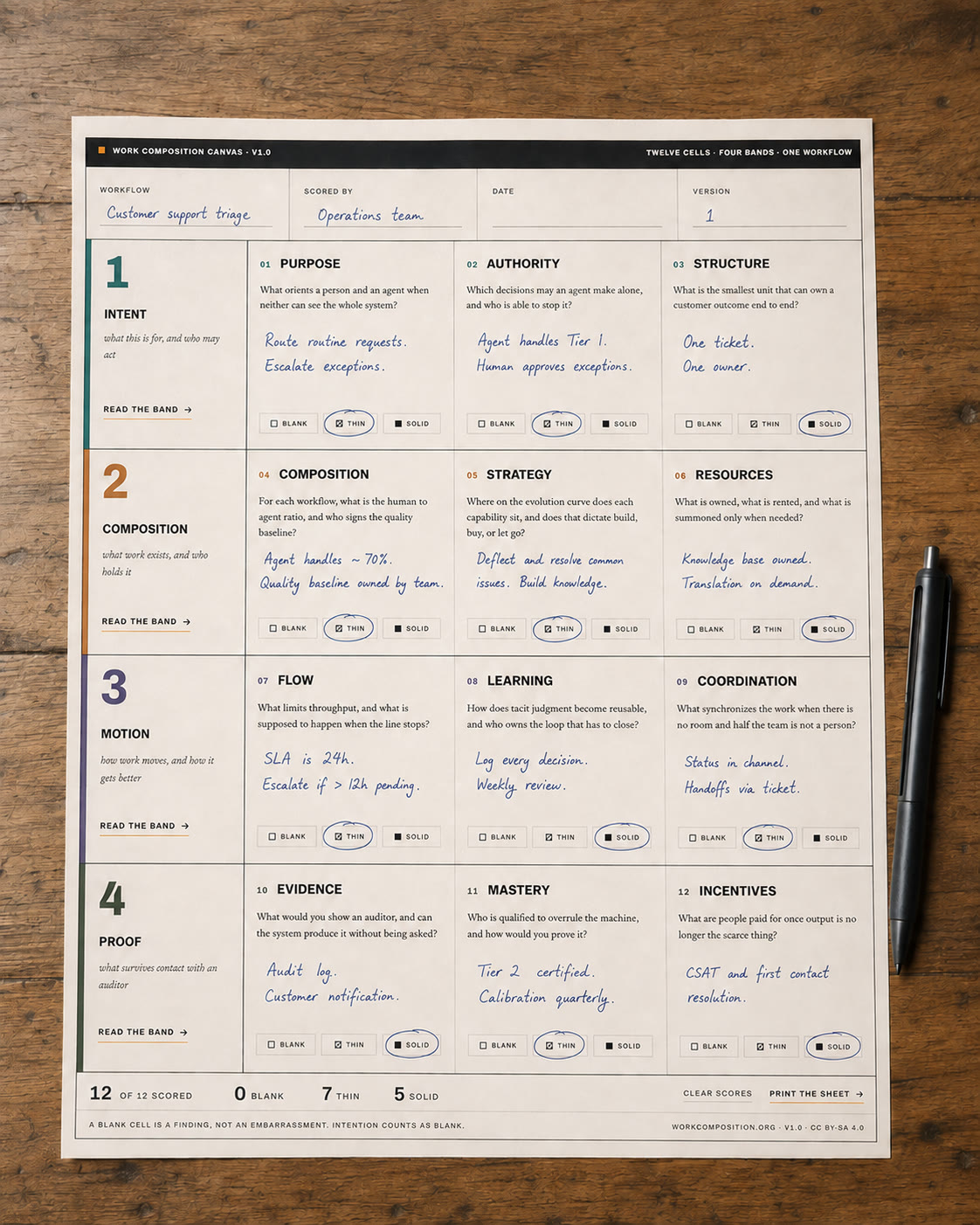
Before handing work to AI, make the decisions, responsibilities and evidence clear. Use the Work Composition Canvas to examine one workflow, identify what your team needs to prepare for, and define how you will judge the result.
Published by The Euler Center under CC BY-SA 4.0. Free to use, teach, translate, and adapt, with attribution. Published adaptations stay open.
These describe work, not this site. They would hold if you never filled in a canvas or named a pattern. Each one forces a question, and the rest of this site is those six questions asked of one workflow.
Before deciding how to do something, ask what it needs to achieve, and whether it needs to happen at all.
What result is needed? What work can we remove?
Tasks that take the same time may need different knowledge, judgment, skills, or authority.
What does each remaining task require?
What can do one task well may be unsuitable for another.
Who or what can meet those requirements?
Dividing work changes the handoffs, dependencies, and checks needed to finish it.
How will the pieces come together?
An arrangement that succeeds in one setting may fail in another.
What must be in place for this to work?
A claim that something can do the work needs evidence from the conditions in which it will be used.
How will we know it works?
The canvas is the working surface of the method. A team fills it in for a piece of real work and comes away with a description precise enough to argue about: where the judgment sits, what evidence would show the work was done well, and which parts are candidates for delegation.
It is designed to be filled in on paper. Its fields are also specified as structured data, so a completed canvas can be held in a system rather than a drawer, and so descriptions across an organization can be compared rather than merely collected.
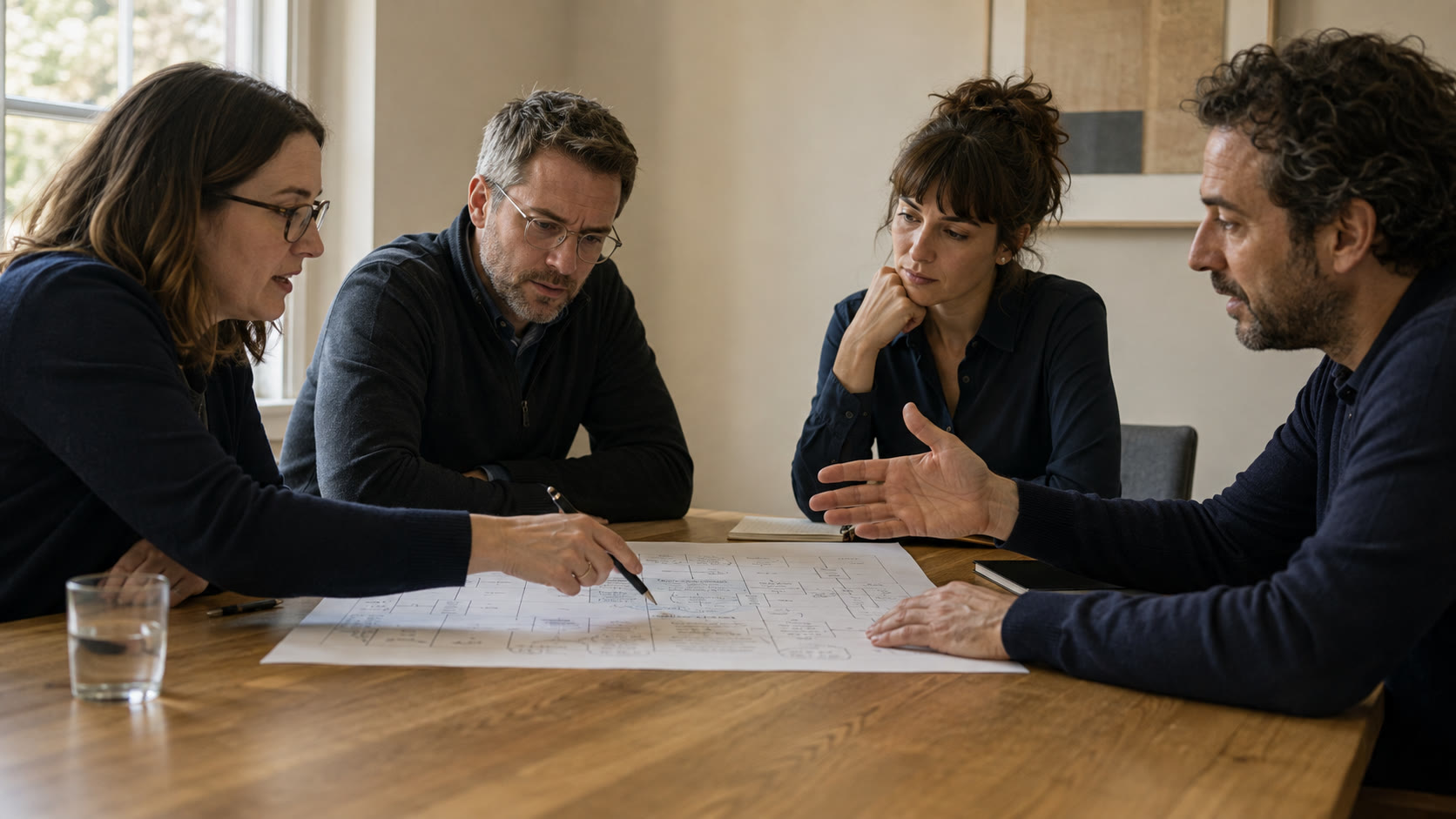
is worth more than a diagram everyone nods at.
Score twelve cells against one real workflow in ninety minutes. Blank, thin, or solid. The output is a list of blank cells with names against them, not a maturity grade.
Deconstruct the work, place each task by problem type, set the loop boundaries, and design the escalation that fires by itself. Six techniques, each with its failure mode.
Six cells solid before an agent ships, the Evidence cell mapped to the regimes you live under, and an assessment that names who may overrule the machine.
No agent reaches production touching regulated work until six cells are solid. Deliberately shorter than the canvas, because a gate people can hold in their head is a gate that gets used. Run it per deployment, not per program.
It exists because organizing has to come before mechanizing, and organizing needs a vocabulary. Process maps describe sequence. Job descriptions describe people. Neither describes composition, which is the thing that changes when agents enter the work.
A description language is only useful if it is shared, and a method that requires a license is not a language. Work Composition is published under CC BY-SA 4.0. Anyone may use, adapt, and implement it, including commercially and including in competing products.
The canvas belongs to everybody, including the consultancies that will compete with us using it. That is the point. A method nobody else will teach is not a standard, it is a sales deck.
Read the thesis: shapes, not beliefsThe lab is collecting completed canvases from teaching cohorts and applied engagements. Aggregate findings will be published as working papers; individual descriptions remain the property of the organizations that made them.
No. The Canvas, worksheets and gate are free tools. An assessed credential remains in development, with pass criteria and assessor arrangements still to be established. A lesson or workflow review does not certify a person.
Yes. It is published under CC BY-SA 4.0. Use it, teach it, translate it, adapt it, and sell services around it, including in competition with us. Name the source, and if you publish an adapted canvas, publish it under the same license so it stays open.
No. Filling in canvases, writing them into your procedures, audit binders, and vendor contracts, and training your own people never triggers the share-alike clause. It applies only if you publish an adaptation of the method itself to the outside world, and then only to that adaptation, never to your completed canvases or the work described on them.
The twelve cells and the six-item gate are stable enough to build on. The scale ships uncalibrated on purpose; you set the anchors for your own workflows. Two of the seven patterns are drafts, and every case is secondhand.
A canvas filled at the level of the enterprise is a poster. A canvas filled at the level of a workflow is a decision. Pick one flow that already has an agent in it, or is about to.
If you want in, the fastest route is to send one thing rather than an introduction: a pattern, a failure, or a correction. That is the whole application.
Send one thing